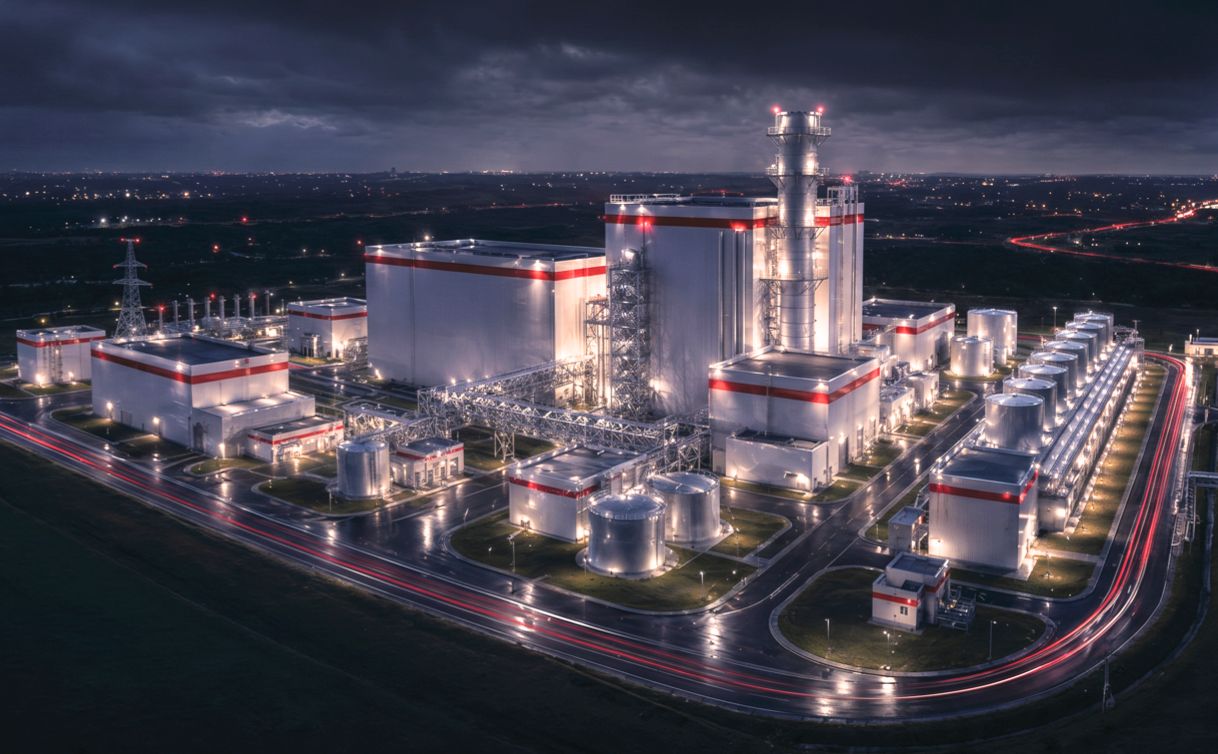
A historic moment for power industry in Pomerania. Construction of Gdańsk power plant gains momentum.
Construction of the first large-scale power unit in northern Poland is picking up speed. The CCGT power plant in Gdańsk is not only an important investment project for the Energa Group itself, as one of the tools for realizing its strategic vision of development. It is also a source of further impetus to strengthen the economy of the city and of the wider region, as well as a key unit supporting Poland’s energy transition.
“Our energy system needs flexibility, seamless cooperation with renewable energy sources, availability and stability. The CCGT power plant in Gdańsk combines all of these elements. This is a key project from the point of view of energy security in Poland and in the region, which has so far lacked such high capacity unit. By building a resilient electricity system, we are also strengthening Polish industry, Polish companies and Polish entrepreneurs. I believe that this investment will become a symbol of responsible development and carefully built energy security for years to come," stresses the Minister of Energy, Miłosz Motyka.
“Gdańsk and the Pomeranian region are facing a historic change. The CCGT Gdańsk unit, currently being built by the Energa Group, will be the first large-scale energy source in Pomerania, significantly boosting Poland’s energy security. Taking into account the gas units currently under construction in Grudziądz, we can conclude that Energa Group is contributing to shifting the weight of system balancing and energy supply towards the north of the country, where such assets have long been lacking. The map of the Polish power system is being redrawn before our eyes, and Energa Group is participating in the process as a key player,” emphasizes Magdalena Kamińska, President of Energa SA’s Management Board.
Earthworks are already underway at the construction site of the Gdańsk power plant. Basic utility connections have already been completed, and internal roads are gradually being created. Construction work is taking place in parallel. The implementation of the outside battery limits (OSBL) auxiliary infrastructure has also begun, including, among other things, the raw water supply system necessary for the future operation of the power plant.
“Energa Group is actively involved in the energy transition in its key aspects. Not only are we developing renewable energy sources, which are essential for decarbonizing the energy industry, but we are also investing in sources that will feed the National Grid System in case of less favourable weather conditions. Therefore, Gdańsk power plant is of great importance for the security of Poland's energy supply. During its first 20 years of operation, the unit will produce more than 43 TWh of electricity. Annually, it will be able to support more than a million Polish households at times when production from renewable sources is insufficient,” says Grzegorz Błędowski, President of the Management Board of CCGT Gdańsk Sp. z o.o.
The CCGT Gdańsk power plant, with a net capacity of about 560 MW, is a considerable undertaking. At peak times, nearly 700 people will be present on-site for the construction work. The team will work a total of about 3 million man-hours. Polimex Mostostal, the leader of the consortium of companies working on the CCGT Gdańsk unit, plans to incur about 80 percent of its project expenses in Poland, while cooperating with about 150 domestic subcontractors and suppliers. Once operational, the Gdańsk power plant will employ a team of about 60 skilled workers.
“The construction of the CCGT plant in Gdańsk is of fundamental importance to Poland's energy security and a key step in the transition to low-carbon operations. As the leader of the consortium and the undisputed leader of the Polish energy construction market, we are proud to take on this challenge. We see the CCGT Gdańsk project not only as another great investment, but first and foremost as proof of the huge role local content plays in the state's strategic projects. We are betting on Polish technical expertise in the field of construction, on domestic capital and local expertise, actively building a modern energy sector and genuinely enhancing the potential of the Polish economy,” adds Jakub Stypuła, President of the Management Board of Polimex Mostostal S.A.
Work is gaining momentum
Special piles are being installed at the construction site to further strengthen the foundations of the buildings by compacting the soil. Piling has already been completed for the foundations of the engine room and the core of the unit - two turbines with a generator, which together will weigh more than a thousand tons. Currently, piles are being inserted for the foundations of the Heat Recovery Steam Generator (HRSG). Each pile will measure up to 60 centimetres in width and reach a maximum of 25.4 meters deep into the ground. In the upcoming months, piling will be completed for other power plant buildings, such as the cooling tower and water treatment buildings.
To reduce the impact of the project on the surrounding area, piles are not driven into the ground. Instead, concrete is poured into pre-drilled holes. Such an approach generates much less noise and vibration. After the boreholes are filled with concrete, the mixture sets for about a month, after which individual piles undergo loading and continuity tests.
The first proper foundation work is scheduled to begin in the second half of 2026. Delivery of key elements – turbines and generator, which are the heart of the power plant - should take place in 2027. Siemens Energy turbines and generators will be identical to the solutions used in Energa Group’s investment projects in Grudziądz.
“The power plant will help enhance Poland's energy security and strengthen the energy transition by providing flexible and efficient generation capacity to support the power grid as more RES sources are connected. Siemens Energy will supply the key components of the unit: the turbines and a generator, which are the "heart" of the unit with a capacity of about 560 MW. The technology combines high efficiency with flexibility: it can be put into operation quickly and provide stable grid support when renewable energy production drops,” notes Grzegorz Należyty, President of Siemens Energy in Poland.
Power supply for millions of Poles
The Gdańsk power plant is one of four CCGT units under construction by Energa Group. More are being built in Grudziądz (two units) and Ostrołęka. Their total installed capacity will be about 2.4 GW. The units will be able to produce enough electricity to power an average of nearly 5.5 million households per year.
Natural gas-fired power plants, such as Energa Group's CCGT units, will support Poland's energy transition, securing the supply of power and electricity in the face of the projected increase in demand for electricity and the expected gradual disconnection from the national grid of increasingly obsolete coal-fired units with lower efficiency and availability. CCGT units have lower emission indicators than coal-fired power plants. What's more, the power plants under construction will be ready for very fast startup and shutdown, and for dynamic power changes. Therefore, their operational flexibility will allow the CCGT units to respond more efficiently to the challenges and requirements of the modern energy system.
***